What is design thinking?
It’s a methodology, Brown from Harvard Business Review quotes “The full spectrum of innovation activities with a human-centered design ethos.” (2008, p. 1)

“Sometimes inspiration starts from squiggles”
We checked out the German team – Reinigungsgesellschaft and their work included Readymade Protest, cycling to produce energy.


These guys are in Perth working on The City of Vincent titled “Urban Storylines” (2012). The below is from their website. (“Reinigungsgesellschaft”, 2012)
What´s planned?
The aim is to carry out an artistic project in three steps that puts the human society in relationship to urban structures in the center of interest:
- dialogue with inhabitants
- transformation of the captured stories and images into graphics
- display of the graphics in public space
Dialogue
The project will examine the geographic and social space by researching cultural identities of Vincent residents. The project grasps the non-visible structures of the area, e.g. legends, self-organized structures of the population, life dreams of the inhabitants and the reflection of them in their story-telling and discussions. In a comparable way like the German Grimm Brothers, who wrote and collected fairy tales in the 19th century in Germany, we will collect stories and legends on interesting events from the inhabitants of Vincent.
Transformation and Visualisation
There will be a phase of conception and image production in the middle of the project. Finally we will realize a public poster campaign. RG will produce the design and layout. The strong graphic appearance creates a recognizable signature in public space and by communicating the future oriented topics the project creates possibilities for new identifications.
Display
The stories will correspond with the urban situation. Also there will be a short explanation and background information of the process, the participants and the framework. After finishing we propose a public event. There could be organized a walking tour along the route with the displays.
So, when I refer back to our group project in design thinking, we have created the ideas (starting point) and we only wanted to focus on some aspects of the festival but after this week consultation, the lecturers weren’t too keen on the overall project, we need to add more to better meet the client’s needs.
The feedback was:
- Lacking ‘flavour’
- Needed to push to next level
- Lack of activities therefore lack of engagement with families. Can families be involved in creating/making the festival
- Liked the pop up bar
- Did not like the logo
All in all, it was disheartening considering it’s the week before presentation but with any downside, there is hopefully an upside. So back to the drawing board…
And these are more of our design thinking:
- Kids Christmas Blue light disco
- Decorate battery operated bauble to hang at the festival tree for official opening
- Paint your own ceramic Christmas tree
- Santa’s helpers hand out bon bon give aways
- Santa’s workshop (Creche) – meet and greet Santa and photo opportunity
- At various locations on the street there will be face paint, balloons giveaways, slushy and icecream stations
- City of Vincent Kids Pass. Find clues on the street and correct answer and location gets a stamp. When all stamps completed, kids get a small prize.
We are crossing our fingers that this will take us to the next level. Design thinking as Brown quotes is “99% Perspiration”. (2001, p. 1)
Reference:
Brown, T. (2008). Design Thinking. Harvard Business Review. Retrieved from http://scholar.google.com.au/scholar_url?hl=en&q=http://www.unusualleading.com/wp-content/uploads/2009/12/HBR-on-Design-Thinking.pdf&sa=X&scisig=AAGBfm12Y0Y80Wt0Ni5y_RSencDxvKds9A&oi=scholarr&ei=VdeKUMT9NpHirAeA2oGoBw&ved=0CCEQgAMoAjAA
Martin, R. (n.d.). Design Thinking. Retrieved from http://rogerlmartin.com/wp-content/uploads/2009/10/h_devotion_design_thinking.gif
Reinigungsgesellschaft. [2012]. Available from http://www.reinigungsgesellschaft.de/home/home.htm
Time flies when you want things to slow down. Week 12 and the countdown to finish is near. I’m going to speed through Week 11 lecture. So what happened?
We had a guest speaker, Charmaine Cave from Cave Design – a book graphic designer giving us an insight to her lifeworld and what to expect for portfolios. She is also the vice president of AGDA.
This is the cover design that Charmaine won for the ‘Get Reading’ program initiated by the government for the Australian Council for the Arts.

In a nutshell:
- Put the BEST pieces in folio – max of 12
- Obvious ‘real jobs’ or industry work experience
- Keep it brief
- Brief descriptions of pieces
- Put in concept – ‘thinking process’
And above all ‘DON’T STRESS!‘ If employers flicked through quickly or slowly – they are looking at your style.
Easier said then done…
Reference:
Cave Design. [2012]. Available from the Cave Design website: http://www.cavedesign.com.au/index.html
Hello and welcome. It’s been a little more than 2 weeks since I last blogged but a break is in desperate need. Now, recharged and ready for more brain strain, it’s time to get down to business, as the semester is drawing to an end. Sad… but no time to stop and grieve, gotta keep moving and this week, the lecture topic is on identity.
There are a few questions that need to address such as…
What is identity? What is pictograms?
What is branding?
What’s the message to the audience?
How does this all fit in with the overall project?
So what is identity?
Identity in sociology means “The collective aspect of the set of characteristics by which a thing/a person is definitively recognizable or known.” (Cape Sociology, 2012)
Identity in business as defined by the Business Dictionary is “Combination of colour schemes, design, words etc, that a firm employs to make a visual statement about itself and to communicate its business philosophy… how a firm view itself, how it wishes to be viewed by others, and how others recognise and remember it.”(Corporate identity, n.d.)
The web page further discusses there is a difference between corporate identity and corporate image. Identity is the notion of being ‘out there’ such as uniform, stationery etc – think for example, Apple logo. (Corporate identity, n.d.) Is there a catch phrase that goes with the identity?
What is branding?
Once again, I refer to the Business dictionary and it is defined as “The process involved in creating a unique name and image for a product in the consumers’ mind, mainly through advertising campaigns with a consistent theme.” (Branding, n.d.)
In today’s lecture, we checked out Köln Bonn Airport identity – “So Simple”. (“Köln Bonn Airport,” n.d.)
In the previous blog, the group activity was on airport experiences and since the process is universal it makes sense to Keep It Simple Silly. The KISS method which is exactly what these designers have achieved in their icons – simplified, recognisable pictograms for passenger ease.
What are pictograms?
This various definitions have been simplified by Walters as:
- “An element of a system of absolute validity.” – Otto Neurath
- “It must have the character of a sign and should not be an illustration.” – Otl Aicher
- “It is an iconic sign that depicts the character of what is being represented.”– H.W. Kapitzki
- ” The purpose of a pictogram is to make our lives easier and safer. For a pictogram to work it must be instantly recognisable and understood by all. Therefore the image must be kept simple and consistent.” (2010, June 14)

(Walters, 2010, June 14)
At a closer look, the pictograms’ simplicity fits the overall image of how an airport should operate – minus the stress! When further looking into their website, the designers have also made the look interactively engaging with animation, bright colours distorting out of the pictograms, giveaways such as postcards, collectible plane. These designers have pushed the product into this overall service the traveller can get before they get to the ‘real thing’ of boarding the plane.
This is an eye opener for our project as there are questions we need to address with our project such as:
- Do we have a catch phrase/motto?
- How do the people see our product (the festival) before the festival commences? Is it newspaper, mags, social media etc.
- Think about the situation when using our service.
- Think about the identity and how it fits in with the situation.
A final word of thought for our project…. Less Brand, More Identity.
Reference:
Branding. [n.d.]. Retrieved from the Business Dictionary website: http://www.businessdictionary.com/definition/branding.html
Cape Sociology. (2012). Definition Identity. Retrieved from the Cape Sociology website: http://www.capesociology.org/definition-identity-32.html
Corporate Identity. [n.d.]. Retrieved from the Business Dictionary website: http://www.businessdictionary.com/definition/corporate-identity.html
Köln Bonn Airport. [n.d.]. Retrieved from the Köln Bonn Airport website: http://www.koeln-bonn-airport.de/
Walters, S. (2010, June 14). Pictograms, International Communication and Cultural Diversity (Part 1) [Web log post]. Retrieved from http://wayfindinguk.wordpress.com/2010/06/14/pictograms-international-communication-and-cultural-diversity-part-1/
Hi.
As this is a week 13/14 unit and we are more than half way, it is becoming overwhelming just how much work is involved.
Our purpose of this Christmas festival is bring together all the elements that are currently instill in Leederville and expand it into the streets. In a nutshell, we are proposing:
- A family venue with increase entertainment for children and the arrival of Santa.
- We are introducing pop up bars.
- We are providing easier mode of transportation and therefore limiting car park.
- We are segregating our festival into colour coding to make wayfinding easier.
- And hopefully, a ‘wow’ factor in our overall setup.
And now onto the inputs…
I’m not entirely sure what inputs are except what I think the word means in a business sense as perhaps a process of breaking down further each entity so it can be manage easier and responsibilities can be delegate into a time frame. I believe this is the time of critical decision making such as the budget, time, resources etc is allocated.
Inputs are essential because it is the nitty gritty of planning.
Creche
- We need people with ‘licence to work with children’ authority paperwork.
- How many people for 8 children.
- What is the maximum capacity?
- We need emergency medical forms filled.
- Are the staff first aid trained?
- Need people to register children (admin. skills)
- Look at Ikea Play center for ideas.
- Need entertainment and activities whilst in queue.
Parent supervision would be appreciated. - Look into supplier for installation and take down of rides, jumping castles. What are the costs involved and can we negotiate a deal for repeat business?
- Look into supplier for Santa’s workshop.
- Look into hire of artificial trees, decorations and snow machine.
- Order “Oxford Street Festival” t-shirts for staff.
- Review pay for staff and added benefits such as free lunch and drink.
- Collaborate with surrounding day cares staff to assist on the day – bring community together and get to know each other
- How long will it take to set up.
- Emergency evacuation process.
Set Design – Overhead props
- Who do we ask for authoritisation?
- Who do we get to set up? Will the supplier set up or recommendations?
- How long will it take to setup?
- What’s the insurance for workplace injury?
- The material data sheet (MDS) for equipment used and conditions of use.
- What sort of Occupational Health and Safety is in place.
- How many people it will take to set up the overhead decorations.
Set Design – Ground Floor Props
- Look at Bindoon Emu and Deer Farm or West Oz Wildlife for the hire of deers, deer food and cost of transportation.
- Hire of fencing – cost
- Hire of trees, lighting and decorations for islands and side walks.
- Hire Santas – need possibly 4 to rotate. 2 at either end as Oxford Street is very long street.

Pop Up Bars
- Container style that can be hired.
- Bar staff with liquor license.
- How many staff per bar is the minimum allowed.
- Occupational Health and Safety to be reviewed.
- How many bars for the street?
- Set up staff – supplier assistance required.
- Where will the liquor be stored at close of trade.
- How many types of liquor will be served. Will it be themed specific? For example, Heineken Beer Bar stock only or only 5 types of top beer served to speed up the queue.
- Will there be seating?
I’m sure there is more that I missed but when reviewing this list, it is overwhelming that preparation is the key. There is a saying we used when I worked in retail – Preparation prevents P@#$% poor performance!
So this is stage one of our planning. WATCH THIS SPACE.
Dawn
There’s a lot to get through in this week’s blog…. the research development.
So, I want to question my research development when I visit Leederville so that I can formulate our concept for the festival.
Research question development is the initial process of questioning “what’s wrong” after developing a problem statement and then test the theories based on information found before conclusion. Lipowski (2008, p. 1667) quotes “Research is designed to generate information that cannot be gained from any other source.”
What is its identity?
- Does it resemble any other suburb?
- Where’s the history?
- What is the Town of Vincent overall development plans?
Environment Sustainability
- Does it have one?
Wayfinding
- Does it have one? and is it clear to distinguish?
- What’s it traffic like and its there any crossroads?
Entertainment
- How many venues of nightclubs and bars?
- Any venue for kids?
Transportation
- What’s the prefer mode? IS there enough car parks? What are the parking fees like? Does it encourage people to come?
- What’s the public transport like? Is it convenient?
Food
- What’s the range like?
- How competitive is it?
- Is it value for money?
Retail
- What’s the store look like? Does it fit in with the overall look?
- What’s the price range?
- Shoppable space?
- What’s the range like?
Well… firstly, I managed to get statistics on the demographics of Leederville from Domain (2012).
| Age | Between 20 and 39: 41%Median is :34 |
| Marital Status | Never Married: 44% |
| Occupation | Prof: 18% Clerk/sales: 9% |
| Income | Indiv: $715 Fam: $1811 |
| Nature of Occupancy | 41% Rent, 30% Owed |
| Education | 75% working, 10% Uni |
So how does this all fit in with our design? And what is our design proposal for Leederville festival? Tune in for Week 8 where I discuss our concept and inputs.
Have a good one,
Dawn
Reference:
Lipowski, E. (2008). Developing great research questions. American Society of Health-System Pharmacists, Inc. . 65, 1667- 1670. doi: 10.2146/ajhp070276
West Leederville suburb profile. (2012). Available from http://www.domain.com.au/Public/suburbprofile.aspx?mode=research&searchTerm=West%20Leederville
Heya,
Since the site visit, it is apparent that I cannot achieve the outcome that I want solo and I am now collaborating with another interior designer. We have splits the responsibilities as such:
I will be tackling advertising and marketing, creche and the set design of the props while the other designer will be designing the pop up bar concept and all the CAD drawing.

But, before even drawing concepts, we need to define the problem statement. The Project Management Hut (2007) defines problem statement as ” lists the essentialities of the project and enables the project manager to identify the scope of the project and all the related stakeholders. The problem statement acknowledges the complexity of the project and calls for breaking up the whole project into various subprojects that can easily be executed by teams.”
Some of the questions that we, as designers need to ask are:
- Why do we need to change Leederville?
- What is the issue? it a local or global? i.e. for tourism or geographical
- Where is the issue?
- Who does the problem affect? Businesses, residentials, customers, employees
- What do we want from businesses?
- When did the issues started and when does it need to fix – deadline?
- What happens when the issue is fixed and what happens if it’s not fixed?
- What do we want to focus on? Environment, Social or Arts
- Why is this important?
- What are the risks?
- Will businesses support the issue?
- Do we need to ask the public/community want do they want?
- Is the community aware of plans?
I think it’s important that clarity in information and communication is of utmost importance in ensuring the success. I also believe the introduction to the festival must be ‘hyped up’ to create a buzz amongst businesses so they immediately respond to the event positively.
This diagram by Sheldon (2008, November 16) represents how to tackle a problem statement.

Sheldon also quotes (2008, November 16) “successful organizations must continually assess how their organization’s mission and programs fit into the evolving landscape of their communities.”
So here’s my first attempt at my problem statement…
“In order to have a successful Christmas festival, we need to address the cosmetic changes that will impact the businesses and local community and how the two entities can work together to ensure the festival will be successful. The aim of the festival is the closure of the main road, Oxford Street so businesses can promote their business into the street, creating a festive Christmas vibe.
The festival will produce an increase in customer traffic flow and promote Christmas at Leederville as well as local businesses, increasing the day’s revenue. The aim of the festival is for families of all ages to enjoy entertainment, food and beverage, retail therapy and the arrival of Santa.”
Hope that it makes sense…. and I’ll try and develop on that statement more on a later date.
Have a good one!
Dawn
Reference:
Defining Six Sigma Projects. (2007). Retrieved from The Project Management Hut web site: http://www.pmhut.com/defining-six-sigma-projects
Sheldon, B. (2008, November 16). Strengthening Organisations through Community Engagement. [web log post]. Retrieved from http://www.island94.org/2008/11/strengthening-organizations-through-community-engagement/
User Perspective and Problem Statements. (2011). Available from http://birch.co/post/4987768109/user-perspective-and-problem-statements
Welcome back,
This week we are off on a class excursion to Leederville for site visit. I’m looking forward to this because after last week’s class, I’d pretty much made up my mind to accept Oxford Street as my challenge. Mostly because of the Christmas theme which I’m a sucker for. And what I have in mind is pretty big to do solo too.
The slideshow gives only a small snap shot of Leedy but when I took a step back and REALLY looked, it hasn’t change much since I’d started clubbing and I’m no spring chicken! The hub is around Newcastle to Vincent Street which doesn’t leave the rest of Oxford Street a chance to thrive. The place has that Melbournian atmosphere but is a long shot from achieving that and frankly, I’d rather be seen at Beaufort Street than Leederville. Harsh but to sum up what’s not right about Leederville is its lack of identity. Had I not taken on board this project, I wouldn’t delve into its cultural heritage.
It was only in the 1990s (fairly recent) that the businesses in this cafe strip had a facelift. Did anyone know that the Leederville Hotel was previously Swan Brewing Company Ltd? (Town of Vincent Local Studies, 2005) That, Lake Monger on the Eastern bank was a rubbish tip until 1965? (Town of Vincent Local Studies, 2005)
I don’t understand why some of the history was not informed to the public in a relevant artwork. I understand this history can be applied to any suburb but it’s a tourist attraction. Beyonce has obviously heard about Leederville cause she came, she saw and conquer the shopping!
So what’s wrong with Leederville?
- Identity. The shop fronts need a facelift and fit in with the cosmopolitan look. No offense to Subway but does it belong there or at least change the store’s exterior.
- Why is there a fenced off car park perfect for the undesirables to deal drugs?
- The landscape. Not enough trees consistently planted in ALL the islands of Oxford Street. Is it ok for only the hub to have nice shading but not the islands towards Bourke Street? There should be more native greenery planted with the trees.
- General maintenance. Stickers on poles that are layered with more stickers.
- Quite a few alleyways that aren’t utilised. Public art would be ideal.
- Brick paving….. could break up the monotonous red bricks with public art/touch points?
- Something for the kiddies other than the non-existent park or build a cafe around the park since mothers LOVE an excuse to take the little ones for baby cinos.

Ok, I know I’m bagging this place out but really all it needs a busy bee landscape cleanup first and it would be good as gold! Leederville is still a place to eat and club but it’s also a place to have a coffee and people watch (NOT in a creepy or stalker way) and to sustain this cosmopolitan look it needs to take a note from the French – nonchalant. A couple of places have hit the mark such The Garden, Green & Co. and San Churros – not because of my love for chocolate and coffee but the relax atmosphere and the right to lick the chocolate cleanly from the bowls without judgement!
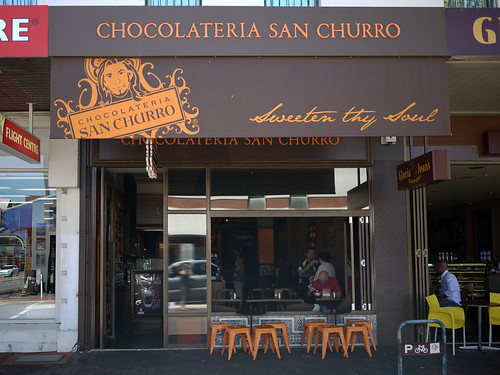
Hope to see you for the next blog.
Dawn
Reference:
A Brief History of the Suburb Leederville. (2005). Retrieved from the Town of Vincent Local Studies web site: http://www.vincentheritage.com.au/pdf/leederville2.pdf
The Food Pornographer. (2011, February 28). Chocolateria San Churros, Leederville. Retrieved from http://www.thefoodpornographer.com/2011/02/28/chocolateria-san-churro-leederville/
G’Day,
This week we are FINALLY sinking our teeth into the actual project although I know it’s always the number 1 priority of prepping but I’d like to get my head around it so I can start planning what to do and how much time I need to allocate as we all know there is only so many hours in a day. AND, next thing you know, it bites you in the ‘beep’.
Today, in class the two festivals – Oxford Street and Beaufort Street were discussed on what opportunities could be in either of the festivals.
Beaufort Street
- Pop up entry way at either street entrance
- Wayfinding
- Directional/flow of customer traffic
- Pop up themes

Beaufort Street Festival Map 2010
Oxford Street Festival
- Want Christmas themed festival
- Proposed date Sat 8 December 2012
- Want retail, food theme
- Pop up themes
- Link festival in conjunction with another festival
- Branding
- Public art works
I joined two of my other collegues and brainstormed concepts. This is examples of what we came up with.


Thank you for reading. See you next time.
Dawn
Reference:
My Style Local Net. (2010, November 24). Beaufort Street Festival – Linking the Best of Street Culture. Retrieved from http://mystylelocal.net/blog/?p=1273
Welcome back!
We have been given a list of spatial issues by the Town of Vincent to come up with some solutions but I’ll talk about it later as well as an opportunity to work in teams again.
So… ‘Wicked Problems’. Wicked you say and what is that?

Wicked problem as defined by the Australian Public Service Commission (“Tackling wicked problems”, n.d.) as “an issue highly resistant to resolution”.
How do we tackle wicked problems? To gain any outcomes, we have to go right back to the basic and this requires anybody that would have any part in the problem to be involved. These people have skill sets, experience, knowledge that can contribute to the problem solving. The APSC (“Tackling wicked problems”, n.d.) also sums this perfectly as “tackling wicked problems is an evolving art. They require … grasping the big picture, including the interrelationships among the full range of casual factors underlying them. They often require broader, more collaborative, innovative approaches. This may result in the occasional failure or need for policy change or adjustment.”
Our first port of call – Town of Vincent team.
I believe the challenge is in convincing Town of Vincent that change is necessary for the growth of the suburbs and PERTH needs to taken seriously.
So what are the opportunities???
Beaufort Street, Mt Lawley
- Needs refurbishment, enhancement
- Add vegetation around streets and corners for shade.
- Review traffic, parking.
- Festival
Oxford Street, Leederville
- Same as Beaufort Street.
- Public art?
- Festival for example, Christmas theme
‘The Avenue’ carpark skate park
- Better use of space
- Possibly removing the skate park
- Recycled/industrial public art
Banks Reserve
- Walters Brook Creek redevelopment
- Add ecological protection such as creek mouth
- Add stabilisation such as a bridge
- Provide interactive engagement
- Public Art
- Shade such as gazebo
- Add recreational amusement
- Culture related
- Cafe
Toni Di Scerni Pathway
- Weed management plans
Bio-filtration system research
- site specific
Public Art Design
- Recycled materials
- Culture related
- Interactive art work
Feature Interpretive Art Design
- Surburb/history related
CHOICES, CHOICES!
Ok now, so let’s work on an example. THE PEG. Mmmm, how can a humble household item be such an interesting read?
As designers we must ask ourselves, if a client presents an idea no matter how strange it may seem, the idea is still a wicked problem.
- Wicked problems run counter to many a designer’s understanding of their professional role.
- “Object based thinking”
- Information problem
- Wicked problems are the system of other (usually bigger, more wicked) problems
In the case of our humble Peg, it is the answer to a social problem.
Some of the questions to ask are:
- Who’s it for?
- What’s wrong with the original design? Do we need to fix what’s not broke?
- Materials
- Functionality
- Is it specific to a particular clothesline?
- Is there a short term solution?
- Budget
- Time
- Do we need pegs?
- Cost vs production cost
Below are images of group work.


When reviewing the opportunities for Town of Vincent, they are indeed in dire need of enhancement but I think I’m gearing towards Christmas at Oxford Street Festival because we need to inject Christmas joy into our busy lifestyle and I can’t wait to start designing. My dilemma is do I work in a group or go solo that is the question….
Happy reading and signing off,
Dawn
Reference:
Natalizio, M. (2011). What keeps you up at night? Identify your wicked problems. [Web log post] http://hni.com/Portals/38664/images/WickedonBlue.png
Tackling wicked problems. [n.d.]. Retrieved from the Australian Public Service Commission website: http://www.apsc.gov.au/publications-and-media/archive/publications-archive/tackling-wicked-problem
Hi All,
Welcome back. This week, there is no mucking around as we were delved straight into Service Design.
Service Design is a design experience.
It is about designers introducing methods that can be adopted and adapted by organisations.
“Service Design is the design of the overall experience of a service as well as the
design of the process and strategy to provide that service”
Stefan Moritz, 2005, Service Design Network
Service Design IS:
- Shifting the focus from designing object to designing processes. Processes such as human to human or human to object. For example, a logo is a touch point.
- The design of touch points should provide holistic experiences to stakeholders.
Service Design IS NOT:
- Limited to design artifact, logo, poster, brochures etc. Service design is concern about the holistic experience that end users get from these artifacts.
- Unrealistic
- Merely being ‘unrealistic’
Check out the below site on service design.
An introduction video to service design by by sdnetwork on Vimeo.
Service prototype layout:

Service Design Network (Scott, 2009) defines service prototyping as:
a) methods that allow designers, clients or users to “experience it themselves” rather than witnessing a demonstration of someone else’s experience.
b) an approach to prototyping that encourages us to think of interactions with product, space, service or system as integrated with the dynamic aspects of time and space, as they are actually experienced by people in their context, rather than one or more specific isolated artifacts.
Let me give an example of a class exercise.
We did an empathy map.
Purpose: To identify users’ needs. To visualise user’s experience and to identify touch points
How: Divide your paper into 4 sections. Draw in diagrams, or storyboards that service design. Think of a potential user for your service. Now try to note down what they:-
- Do: What actions would s/he take?
- Say: What words/sentences would s/he use?
- Think: What might s/he be thinking/believing?
- Feel: What can be her/his emotional state?
I worked in a group for this one so check out the below link.
Many thanks for reading, Happy Days.
Dawn
Reference:
Scott, J. (2009). Experience Prototyping. Service Design Network. Retrieved from http://www.service-design-network.org/content/experience-prototyping
Service Design Network. [n.d.]. Available from http://www.service-design-network.org/


